%2FKinvara%20Private%20Hospital%20logo.png&w=640&q=75)
Cosmetic Surgery
Is Liposuction Permanent? What to Know About Long-Term Results
Liposuction is one of the most popular cosmetic procedures in the world, so it is no surprise that one of the most common questions asked is whether the results are permanent. Fat cells that are removed are gone for good, but how the area looks over the years still depends on you.
- Medically reviewed by
- Medically reviewed by Mr Vasu Karri, Consultant Plastic Surgeon, FRCS(Plast), GMC 4631035
- First published
- Last reviewed
- Next review due
- 14 June 2027
- Reading time
- 6 min
In this article (10 sections)
- How liposuction works, and why that matters
- Permanent, or just long lasting?
- What happens if you gain weight afterwards?
- Is it a way to lose weight?
- How ageing and skin affect the result
- What to expect in the first year
- Habits that help your result last
- Common myths about liposuction
- Why a hospital setting matters
- Is liposuction right for you?
How liposuction works, and why that matters
In short
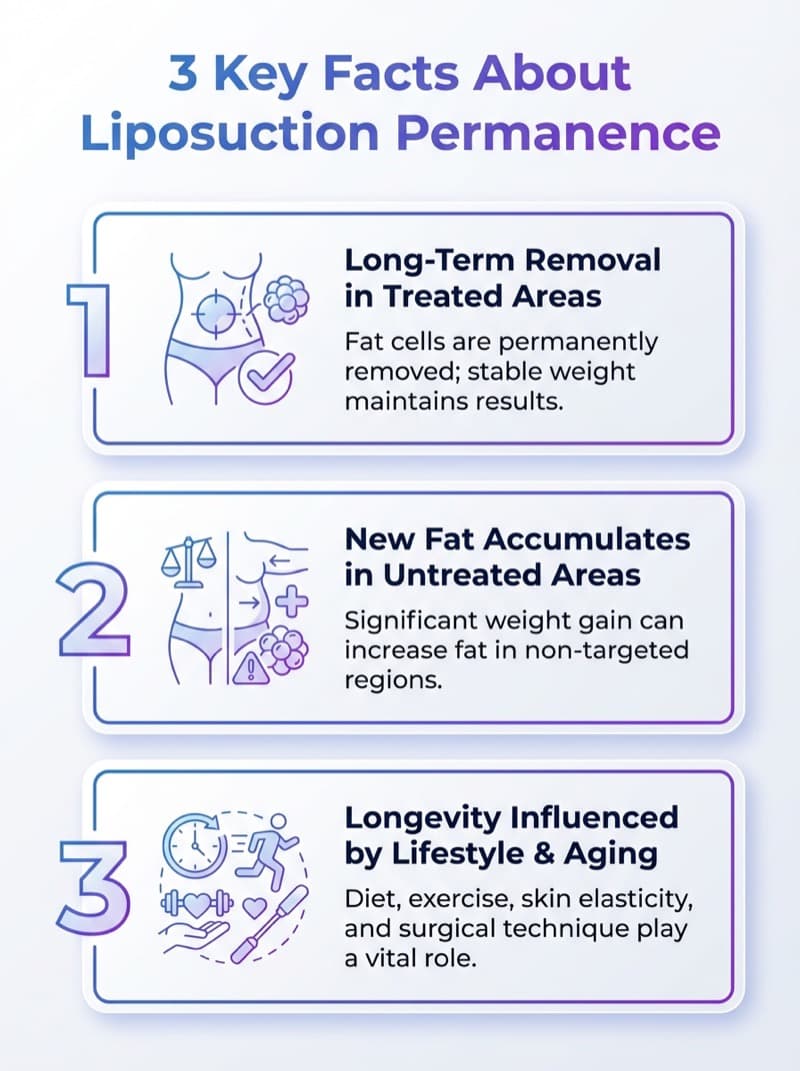
Liposuction permanently removes a portion of fat cells, and those cells do not grow back. The result is long lasting rather than fixed for life: a stable weight and healthy habits keep it looking its best, while weight gain and natural ageing still change your shape.
During liposuction, a surgeon makes tiny cuts in the skin and passes a thin tube called a cannula through them, using gentle suction to remove fat cells from the area being treated. A proportion of the fat cells in that area are physically taken away.
The fat cells that are left behind do not replicate, and those remaining cells can still store fat if you put on weight. This is why liposuction permanently removes a portion of your fat cells without freezing your body shape in time. Your lifestyle and natural ageing still shape how the area looks in the years that follow.
Permanent, or just long lasting?
The fairest answer is that liposuction is permanent at the level of the fat cells, while the result you see is long lasting rather than fixed for life. Guidance from plastic surgery bodies is that results hold up well when you keep a stable weight and reasonable fitness, although ageing softens the improvement over time.
In practice, if you stay roughly the same weight for years, the treated areas usually keep their slimmer shape. If your weight swings up and down, your shape will change again, even though the exact fat cells that were removed have not come back. It helps to think of liposuction as a way of reshaping stubborn areas rather than a one-off fix that replaces healthy habits, and that view tends to give the most satisfying results.
What happens if you gain weight afterwards?
If you gain weight after liposuction, your body stores the new fat across the cells that remain, in both treated and untreated areas. The fat cells themselves do not return to the treated area, but the ones left behind can enlarge, so a large weight gain can bring back some fullness where you had treatment. As a rough guide:
- Small changes of two to three kilograms tend to soften the result slightly while keeping the improved proportions.
- A larger gain, around ten percent or more of your body weight, can change your shape more noticeably.
Is it a way to lose weight?
Liposuction is not a weight loss treatment, even though the scales may move a little afterwards. Studies looking at liposuction and metabolic health report an average weight reduction of only a couple of kilograms, which is modest next to a structured weight loss programme.
It is better to think of liposuction as body contouring, aimed at reshaping areas such as the tummy, thighs or hips that resist diet and exercise. The main goal is how your clothes fit and how balanced your outline looks, not the number on the scales. If overall weight loss is your priority, we would talk through lifestyle, nutrition and medical support first, and often suggest settling your weight before surgery, which also protects your result because we are not operating during a time of rapid change.
How ageing and skin affect the result
Even when fat cells are removed for good, your skin and the tissues that support it carry on ageing, so the long-term look of the area also depends on skin quality and elasticity. Younger or more elastic skin tends to snap back well after liposuction and stay smooth for longer, while older or sun-damaged skin can loosen sooner.
What to expect in the first year
The first twelve months set the foundation for how lasting your result feels, and it helps to see this time as a partnership between the surgery and your day-to-day habits. The change usually settles in stages:
- First few weeks: swelling and bruising are normal, so the area can look larger than you expected at first.
- Three to six months: the swelling settles steadily.
- Around six months: you usually see close to your final shape.
- Up to a year: smaller refinements continue to appear.
Wearing the compression garments we recommend, staying gently active, and avoiding sudden weight gain all support a smoother final result, and many patients tell us this period gives them a strong reason to look after their new shape.
Habits that help your result last
Because the fat cells that are removed are gone, the job afterwards is to look after the ones that remain, and the patients who do best build simple, realistic routines rather than chase strict short-term diets. A few habits make the biggest difference:
- Keep your weight steady within a few kilograms, as repeated cycles of gaining and losing put the most strain on your shape.
- Eat in a balanced way that you can actually stick to.
- Stay active most days with something that suits your joints, such as walking or swimming.
- Look after your skin with hydration and sun protection.
We do not expect perfection, just consistency. If you treat your result as something to protect rather than something that looks after itself, it lasts far better.
Common myths about liposuction
A few myths come up again and again, and clearing them up helps you judge the procedure on its real merits.
- Myth: the fat simply moves to other areas. The current evidence suggests fat cells do not redistribute in that way.
- Myth: liposuction stops you ever gaining weight again. You can still gain or lose weight, and how that shows on your frame is shaped by the new spread of fat cells.
- Myth: it fixes loose skin or poor muscle tone on its own. It does not. We sometimes suggest combining it with a lifting or tightening procedure if you want a firmer result and your skin elasticity is limited.
Why a hospital setting matters
Where you have liposuction is as important as the decision to have it, especially if you want a result that lasts. Kinvara Private Hospital is a multi-speciality private hospital in South Yorkshire, with plastic and cosmetic surgery sitting within a wider clinical service, so your care takes place inside a full hospital framework with surgeons, anaesthetists and nurses working together.
This kind of joined-up care is most valuable for procedures where the aftercare and follow-up shape how well the result holds up. Having your reviews, support and any further advice under one roof gives a continuity that is hard to match in a standalone clinic.
Is liposuction right for you?
If you expect liposuction to replace a healthy lifestyle or to hold your body at a certain age, it is likely to disappoint over time. If you see it as a precise way to reshape stubborn areas once you are already close to a comfortable weight, it can be a powerful and lasting tool. The best next step is usually a proper consultation, where you can talk through your goals, have your skin and shape assessed, and ask everything you want to about permanence, scarring, cost and recovery.
Frequently asked questions
Is liposuction permanent?
The fat cells we remove do not grow back, so the change to the treated areas is long lasting as long as you keep a stable weight.
Can fat come back after liposuction?
New fat cannot grow in the cells that were removed, but the fat cells left behind can enlarge if you gain weight, which can bring back some fullness in the treated area.
Is liposuction a weight loss treatment?
No. It is a body contouring procedure that reshapes stubborn areas, not a substitute for diet, exercise or medical weight management.
How long do the results last?
With a steady weight and healthy habits, the change in your contour can last many years, although natural ageing will continue.
How do you decide if liposuction is right for me?
At consultation we look at your general health, skin quality, weight stability and what you hope to achieve before advising whether it suits you.
%2Fmr-vasu-karri.jpg&w=256&q=75)
About the reviewer
Mr Vasu Karri
BSc(Hons), MBBS, MSc, FRCS(Plast)
Mr Vasu Karri is a Consultant Plastic Surgeon and Medical Director of Kinvara Private Hospital, Rotherham. He is on the General Medical Council (GMC) specialist register for plastic surgery.
- GMC 4631035
- FRCS(Plast)
%2FCQC.png&w=384&q=75)
%2FGMC.png&w=384&q=75)
%2FPHIN.png&w=384&q=75)
%2FBritish%20Association%20of%20Plastic%20Surgeons.png&w=384&q=75)
%2FRoyal%20College%20of%20Surgeons.png&w=384&q=75)