Every surgical procedure involves a certain amount of risk, and it is important that you understand the risks involved with lipoedema liposuction.
An individual's choice to undergo a surgical procedure is based on the comparison of the risk to potential benefit. Although the majority of patients do not experience these complications, you should discuss each of them with your Consultant to make sure you understand the risks, potential complications, and consequences of lipoedema liposuction.
1. Scarring – Although the incisions created for lipoedema liposuction are minimal and good wound healing after the procedure is expected, abnormal scars may occur within the skin and deeper tissues in rare cases. Scars can be red, raised, stretched, itchy and painful. Additional treatments, including surgery, may be necessary to treat abnormal scarring.
2. Infection – Infection following lipoedema liposuction is unusual but can occur. Infection can range from erythema to sepsis or necrotising fasciitis. Should an infection arise treatment including antibiotics or additional surgery may be necessary. Although extremely rare, life threatening infections such as sepsis or necrotising fasciitis could occur after surgery, regardless of the technology utilised.
3. Bleeding – While unusual, it is possible to have a bleeding episode during or after surgery. Should postoperative bleeding occur, it may require emergency treatment to drain accumulated blood or require a blood transfusion. Non-prescription herbs and dietary supplements can increase the risk of surgical bleeding. Do not take any aspirin or anti-inflammatory medications for two weeks before surgery, as this may increase the risk of bleeding. Please review our medication list for products and ingredients to be avoided.
4. Chronic Pain – Chronic pain and discomfort following lipoedema liposuction is rare but can occur.
5. Stiffness – The limbs may feel stiff after lipoedema liposuction and this stiffness may persist for several weeks.
6. Bruising and/or Swelling – Bruising and swelling can occur and, in rare situations, persist for several weeks.
7. Asymmetry – There is a risk that your limbs will appear asymmetric after lipoedema liposuction. Almost no one has perfectly symmetrical limbs and any preexisting asymmetry may persist after lipoedema liposuction. Please bear in mind that limb contour also depends on skin elasticity, muscle tone and bony prominences. None of these are affected by liposuction. A degree of asymmetry between the right and left halves of your body is entirely natural.
8. Over/Under Correction – When performing lipoedema liposuction, every effort is made to ensure the lipoedema fat is removed in a systematic and even manner. However, there is always the risk that too much or too little fat is removed from a particular area. As such, adjustment surgery may be necessary at additional cost.
9. Unsatisfactory Result – Although good results are expected, there is no guarantee on the ultimate outcome.
10. Prolonged Postoperative Swelling/Lymphoedema – Postoperative swelling is entirely expected but can last for several weeks. One cannot predict when the swelling will subside. Your postoperative swelling may be shorter or longer in duration than similar patients. There is always the risk of developing lymphoedema in a limb that has undergone liposuction. Lymphoedema may not become apparent until many years after the initial surgery. Furthermore, lipoedema is a progressive condition and lymphoedema can potentially develop as an unrelated issue after surgery.
11. Subcutaneous Irregularities/Nodularity – It is common for the liposuctioned area to feel lumpy, but this tends to settle over time. Permanent irregularities can occur and may be in the form of dents, dimples, grooves, wrinkles or folds.
12. Skin Laxity – In certain areas of the body, the skin is prone to laxity after liposuction. This may be due to poor skin elasticity, which is in turn related to patient age, ethnicity and genetics. Areas prone to laxity after liposuction include the abdomen, posterior arms, medial thighs, suprapatellar region and saddlebag region.
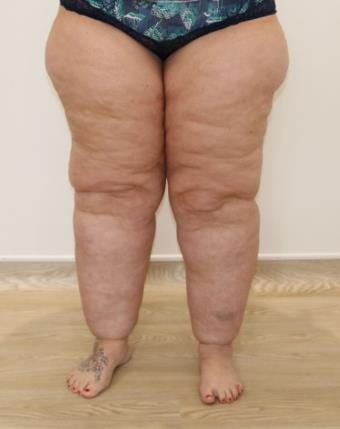
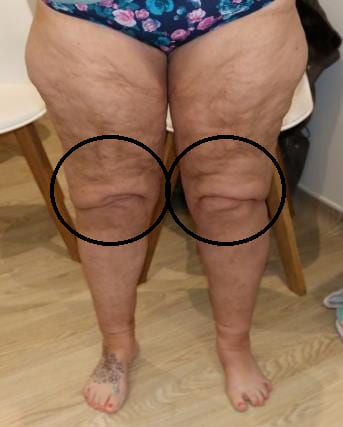
Patient Example with Stage III lipoedema had suprapatellar skin laxity after liposuction (circled area in the photo above).
13. Skin Contour Irregularities – Skin contour irregularities and depressions in the skin are possible. Visible and palpable wrinkling of skin can occur, particularly when large quantities of fat is removed and/or the skin is lacking good elasticity. Postoperative skin contour irregularities could necessitate additional treatments including surgery, at additional cost.
14. Skin Loss – Skin necrosis is a rare complication of liposuction surgery. Skin necrosis can occur if a patient has poor nutrition or is a smoker. Skin necrosis can normally be treated with dressings which will allow the skin edges to heal by secondary intention. In rare cases, the necrotic skin may have to be excised and re-stitched. Poor scarring as a result of skin necrosis can also be treated with either further adjustment surgery once the area has healed.
15. Change in Skin Sensation (Numbness or Hypersensitivity) – Numbness of the skin after liposuction is entirely expected and usually improves over several weeks. Reduced or increased skin sensation that does not completely resolve can occur.
16. Damage to Deeper Structures – Injury to deeper structures including nerves, blood vessels, and muscles is rare but could occur.
17. Seroma – While the incidence and severity of seromas associated with liposuction are not common, such fluid accumulation is possible and could require additional treatments or surgery to promote drainage.
18. Wound Healing Issues – Occasionally wounds can be slow to heal as a result of infection, poor nutrition or poor blood supply. It is important that you tell your Consultant if you smoke or have any history of poor wound healing or scarring.
19. Unresolved Knee Pain – Many lipoedema patients suffer knee pain. This may be related to soft tissue pain or may be due to knee osteoarthritis. There is no guarantee preexisting knee pain will improve after lipoedema liposuction.
20. Fibromyalgia/Chronic Pain Syndromes – There is a risk that lipoedema liposuction can worsen the symptoms of fibromyalgia or other chronic pain syndromes.
21. Risks of Anaesthesia – All forms of anaesthesia or sedation, whether administered locally or generally, carry risks including the possibility of complication, injury, and even death. Risks of general anaesthesia include Deep Vein Thrombosis (DVT), Pulmonary Embolism (PE), drug allergies, cardiorespiratory issues, injury to teeth, pressure sores, ocular injuries and cardiac / respiratory arrest.
22. Pressure Sores (Resulting from Poorly Fitting Compression Garments) – There is a risk that your compression garments may cause pressure sores. This is particularly so around the ankle, where folds in the compression tights can develop. If your compression garments feel too tight or uncomfortable, it is your responsibility to liaise with the provider of your garment to obtain a more comfortable / correctly fitting version. Neither Kinvara Private Hospital, its employees, or your Consultant accepts any responsibility for compression garments that are incorrectly sized, poorly fitting or uncomfortable.
23. Allergic Reactions – Allergies to tape, dressings or suture material, used in lipoedema liposuction can occur. More serious systemic reactions due to drugs administered during surgery and prescription medicines can also arise and may require additional treatment.
24. Long Term Effects – Subsequent alterations in body contour may occur as a result of ageing, weight loss or gain, pregnancy, or other circumstances not related to lipoedema liposuction.
25. Smoking, Second Hand Smoke Exposure and Use of Nicotine Products (Patch, Gum, Nasal Spray) – Patients who are currently smoking, use tobacco products, or nicotine products (patch, gum, or nasal spray) are at a greater risk for significant surgical complications such as skin loss, delayed healing, and additional scarring. Individuals exposed to second hand smoke are also at potential risk for similar complications attributable to nicotine exposure. Additionally, smoking may have a significant negative effect on anaesthesia and recovery from anaesthesia, with coughing and possibly increased bleeding. Individuals who are not exposed to tobacco smoke or nicotine containing products have a significantly lower risk of these types of complication.
If you have previously smoked and stopped, you may still have the effects and therefore the risks of smoking in your system if not enough time has elapsed. It is important to refrain from smoking at least six weeks before surgery and until your Consultant states it is safe to return, if desired. You must inform your Consultant if you continue to smoke within this time frame, and for your safety the surgery, if possible, may be delayed.
Smoking may have such a negative effect on your surgery that a urine or blood test just before surgery may be completed to determine the presence of nicotine. If positive, your surgery may be cancelled, and your surgery fee, scheduling fee, and other prepaid amounts may be forfeited. Be sure to honestly disclose your smoking status to your Consultant. You will be asked to confirm your smoking status and initial the "Smoking or Vaping" declaration later in this form.
26. Sleep Apnoea/CPAP – Individuals who have breathing disorders such as "Obstructive Sleep Apnoea" and who may rely upon Continuous Positive Airway Pressure (CPAP) devices or utilise nighttime oxygen are advised that they are at a substantive risk for respiratory arrest and death when they take narcotic pain medications following surgery. This is an important consideration when evaluating the safety of surgical procedures in terms of very serious complications, including death, which relate to preexisting medical conditions. Surgery may be considered only with monitoring afterwards in a hospital setting in order to reduce risk of potential respiratory complications and to safely manage pain following surgery.
Please consider the following symptoms of sleep apnoea:
- I am frequently tired upon waking and throughout the day.
- I have trouble staying asleep at night.
- I have been told that I snore or stop breathing during sleep.
- I wake up throughout the night or constantly turn from side to side.
- I have been told that my legs or arms jerk while I'm sleeping.
- I make abrupt snorting noises during sleep.
- I feel tired or fall asleep during the day.
It is important for you to inform and discuss any of the above symptoms that you have experienced with your Consultant.
27. DVT/PE Risks and Advisory – There is a risk of blood clots, Deep Vein Thrombosis (DVT) and Pulmonary Embolus (PE) with every surgical procedure. It varies with the risk factors below. The higher the number of risk factors, the greater the risk and the more involved you must be in both understanding these risks and, when permitted by your Consultant, walking and moving your legs. There may also be leg stockings, squeezing active leg devices, and possible medicines to help lower your risk.
There are many conditions that may increase or affect risks of clotting. Inform your Consultant about any past or present history of any of the following:
- Past history of blood clots
- Family history of blood clots
- Birth control pills
- Hormone stimulating drugs
- Swollen legs
- History of cancer
- Large dose vitamins
- Varicose veins
- Past illnesses of the heart, liver, lung, or gastrointestinal tract
- History of multiple spontaneous abortions or miscarriages
The methods of preventative therapy include early ambulation when allowed, compression devices (SCD/ICD) and anticoagulation protocols when allowed. It is important that you comply with the therapy discussed with your Consultant. For high risk patients, the risks of VTE are still high, even in the setting of appropriate chemoprophylaxis. If your surgery is elective and you are a high risk patient, it is best to consider not proceeding with such elective surgery. You will be asked to initial the "Anaesthetic Risks" declaration covering DVT/PE later in this form.
28. Patient Selection – Individuals with poor skin tone, medical problems, or unrealistic expectations may not be candidates for lipoedema liposuction.
29. Pulmonary Complications – In extremely rare cases, fat droplets could become trapped in the lungs to create a possibly fatal complication called fat embolism syndrome. Pulmonary complications may occur secondarily to blood clots (pulmonary emboli) or partial collapse of the lungs after general anaesthesia. Should either of these complications occur, you may require hospitalisation and additional treatment. In some circumstances, pulmonary emboli can be life threatening or fatal.
30. Skin Pigment Changes – Changes in the colour of the skin can occur after lipoedema liposuction, both at the incision sites and across the treated areas. Three types of change are recognised:
- Hyperpigmentation (darkening) at the incision sites. The skin around the small incisions can darken as it heals. This usually fades over several months but can persist for more than a year and, in rare cases, be permanent. It is more common and more persistent in patients with darker skin.
- Haemosiderin staining of the treated areas. Liposuction causes bleeding and bruising under the skin. As the bruising breaks down, the iron pigment in the blood (haemosiderin) can be left behind in the skin, producing a brown, rusty or greyish discolouration across the treated area. It is most common on the lower legs and ankles. Lipoedema patients are at higher risk because they bruise easily, because the legs are the areas most often treated, and because many also have varicose veins or other venous problems. Haemosiderin staining usually fades slowly over many months, but it can be permanent and is difficult to treat.
- Hypopigmentation (lightening) of the treated areas. Less commonly, patches of skin can become lighter than the surrounding skin. This can appear on its own or after an area of darkening has faded. It is more noticeable in darker skin and is harder to treat than darkening.
Exposure of the treated areas to the sun or sunbeds while the skin is healing makes pigment changes darker and longer lasting. You should protect the treated areas from the sun, by covering them or using a high factor sunscreen, for at least twelve months after surgery. Pigment changes should not be regarded as permanent until at least twelve months after surgery. Treatments such as skin lightening creams or laser may improve but not always remove the discolouration, can themselves cause further pigment change, and would be at additional cost.
31. Surgical Shock – Liposuction could conceivably cause severe trauma, particularly when multiple or extensive areas are treated in a single session. Although serious complications are rare, infections or excessive fluid loss could lead to severe illness and even death. Should surgical shock occur following your liposuction, hospitalisation and additional treatment may be necessary. Individuals undergoing liposuction to remove large volumes of fat are at greater risk of complications.
32. Lidocaine Toxicity – There is the possibility that large volumes of fluid containing dilute local anaesthetic drugs and adrenaline that is injected into fatty deposits during surgery may contribute to fluid overload or systemic reaction to these medications. Additional treatment including hospitalisation may be necessary.
33. Disappointment with Results – While we have attempted to assist you in building realistic expectations for your lipoedema liposuction, you may be disappointed with your surgical results. However infrequent, it may be necessary in your case to perform additional surgery to improve results, at additional cost.
34. Limited Understanding of Lipoedema – Our understanding of lipoedema is very limited and there is no guarantee that your mobility or soft tissue pain associated with lipoedema will improve after surgery. The effect of lipoedema liposuction on preexisting medical conditions is not known and there is a risk that symptoms may be worsened. You should not have lipoedema liposuction if you cannot accept this risk.
%2FKinvara%20Private%20Hospital%20logo.png&w=640&q=75)